The Harlem Hellfighters: When Black Excellence Became a Weapon—and a Warning

Less than 5% of our readers support Hip Hop for the Future with a monthly donation. The price of a Jamba Juice for Black people. That small percentage of funds free Reproductive Justice Events in Bayview Hunters Point, the Bay Area's only weekly Hip Hop Cypher, and our Grassroots Job Program. If just 13% of our subscribers gave monthly, we could open Flow Lounge in San Francisco and San Jose, empowering hundreds more artists every year. Be part of that 13%. 👉🏾 www.HipHopForTheFuture.org
Decorated Enough to Die, Never Enough to Be Free
America has a very specific relationship with Black excellence. It loves our swag the way a thief loves a safe—not because it respects what’s inside, but because it wants access to the contents. The country calls us heroic when we’re saving it, entertaining it, or dying for it. The second we stop performing and start demanding—demanding safety, demanding equity, demanding the receipt for what was promised—suddenly the heroism gets complicated. Suddenly, there are “other factors to consider.”
There is a tax this country levies on Black brilliance. It goes by different names in different rooms, but the rate is always the same: twice as good for half a handshake. You outperform, outwork, and outlast—and at the finish line, somebody hands you a certificate instead of the keys. And the most maddening part isn’t the theft. It’s the outcome. Imagine what we could’ve built if our brilliance wasn’t always spent proving we deserve oxygen.
The 369th Infantry Regiment—the Harlem Hellfighters—is the proof-of-concept.
Who They Were, and Why Their Existence Offended the System

African-American men recruited for the 15th New York National Guard regiment later known as a 369th Infantry Regiment, are headed to Camp Upton, New York for training, ca. 1917-1918. Library of Congress
They started as the 15th New York National Guard, Harlem’s sons, volunteers who stepped forward into a military that was segregated by design. segregated on purpose, because the machinery of white supremacy depends on keeping Black people out of any institution where confidence, competence, and collective power can compound. The only way to ensure division and keep poor, uneducated white people voting against their own interests.
These Black men were New Yorkers. Laborers, musicians, students, workers. Black men from a neighborhood that had already become a crucible of Black intellectual and cultural life. And when the call came to fight for democracy abroad, they answered—not because America had been good to them, but because some of them believed the sacrifice might finally crack something open. Their existence, before they fired a single shot, was already an argument the system didn’t want to have.
They Signed Up to Fight for a Country That Hated Them
The sales pitch was freedom. Democracy. The war to end all wars. Posters. Parades. The whole pageant.
The purchase was Jim Crow in uniform.
Segregated units. Segregated facilities. White officers deciding the ceiling on Black ambition. The Army didn’t just doubt Black capability—it feared Black confidence, and the white fragility insured by integrating Black excellence next to mediocrity. A Black man who had proven himself under fire was a man who could no longer be told he was less than. And that terrified an institution built on exactly that lie.
The insults started before they shipped out. When the 15th Regiment requested inclusion in the farewell parade down Fifth Avenue—a parade celebrating the very war they were enlisting to fight—the request was rejected. And as they marched off, someone told James Reese Europe directly, “Black was not one of the colors of the rainbow.”
Then came Spartanburg, South Carolina, where they were sent for training. The town’s mayor, dutifully quoted in The New York Times, warned that with their “northern ideas about race equality, they will probably expect to be treated like white men,” and that definitely was a problem.

The Discard: How White Supremacy Tried to Loan Them Out to Die
Here is what happened without melodrama, because the facts are damning enough on their own:
The U.S. Army, committed to its segregation policy, couldn’t figure out what to do with a full Black regiment that needed to be deployed. The solution: transfer the 369th to the French Army command. French weapons. French officers above them. French orders. American soldiers—fighting under someone else’s flag because their own country’s military wouldn’t integrate them into its structure. The official framing was logistics. The real framing was expendability.
And the U.S. didn’t stop there. On August 7, 1918, Colonel Louis Albert Linard—the French liaison officer at American General Headquarters—distributed a document titled “Secret Information Concerning Black American Troops” throughout the French armed forces. It instructed French officers not to eat with Black American soldiers, not to shake their hands, not to praise them in front of white Americans, and to prevent French women from any “public expression of intimacy” with Black men. Designed to export American apartheid to European soil. W.E.B. Du Bois was so outraged that he published the full document in The Crisis in May 1919. The U.S. Post Office promptly refused to distribute that issue nationally.
No Backup Turned Into No Retreat
Here is the number that ends the argument about Black military capability—for anybody still pretending it’s up for debate:
191 days.
The 369th spent 191 days in front-line trenches—more continuous time in the line than any other American regiment of comparable size—and they paid for it in blood. About 4,000 men served in the 369th in WWI, and they took roughly 1,400 casualties—about 35% (around 1 in 3). That’s nearly triple the overall American Expeditionary Forces casualty rate (255,000+ out of ~2,000,000—about 1 in 8). That’s not “symbolic service.” That’s sustained exposure to artillery, raids, gas, mud, rats, disease, and the grinding math of attrition that turns green troops into veterans—or into names you never hear again.
And they did it under a command structure that tells you everything about America’s priorities. Because the U.S. Army refused to integrate Black troops into its combat formations, the 369th was attached to the French Army—fighting in French sectors, with French equipment—while still wearing U.S. uniforms. Translation: America wanted their bodies on the battlefield, but didn’t want their presence inside “American” military legitimacy. The French, who had their own empire and their own violence, still treated these men more like soldiers than the U.S. ever intended to.
So imagine what that meant at ground level. New rifles in your hands. A new helmet on your head. French field gear on your back. French officers and French units to your left and right. And you’re doing this while you already know the truth you weren’t supposed to say out loud: your own country couldn’t decide whether you were a soldier or a problem it needed to keep contained.
Then came the part where the myth gets its muscle: combat without the courtesy of relief. Many units rotated in and out of the front. The Hellfighters, by record, stayed in the line long enough that fear stops being a moment and becomes a climate. What the architects of their “usefulness” didn’t account for is what happens when you strip away backup, strip away prestige, strip away the assumption that anybody is coming to save you. Some men break. Some men become terrifyingly good at not breaking.
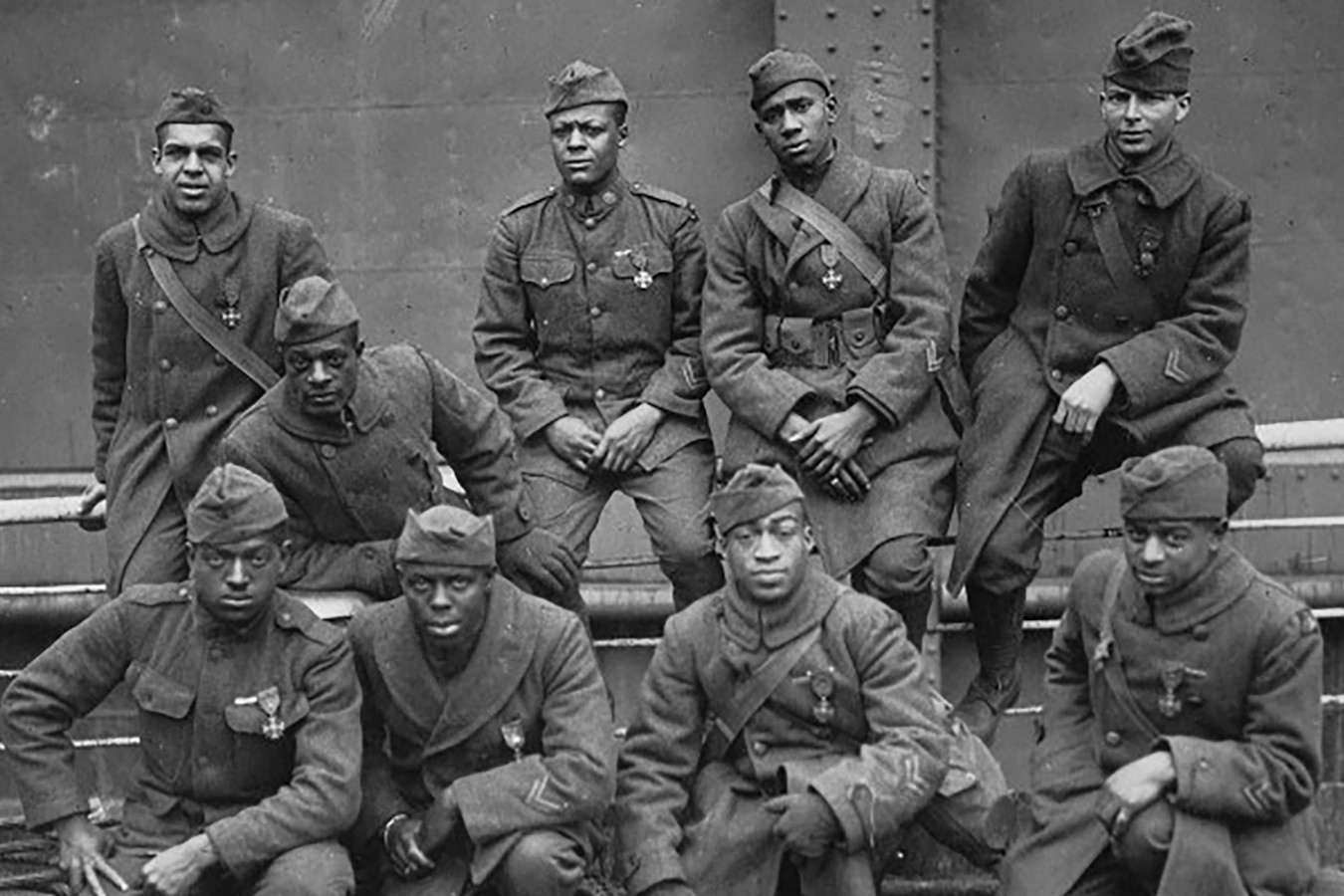
A case study—because stories deserve faces: Henry Johnson and Needham Roberts in May 1918, out on sentry duty, were hit by a German raiding party. Johnson fought through wounds, used rifle fire, grenades, and—when it came down to it—his bolo knife to keep Roberts from being taken and to stop the raid from rolling through the line. France decorated him with the Croix de Guerre; the U.S. dragged its feet for decades on serious recognition, then finally awarded him the Medal of Honor posthumously. That’s the whole American pattern in one night of violence: fight like a legend, come home to a shrug.
And it wasn’t just individual heroics. France recognized the regiment itself, awarding the 369th a Croix de Guerre unit honor for actions in the Maison-en-Champagne campaign. That matters because it shows what they became: not “a Black unit trying to prove something,” but a hardened combat outfit other armies publicly credited for bravery under fire.
That’s what “191 days” really means: not just time, but transformation. A unit the U.S. treated like a liability became a unit the French treated like an asset—seasoned, disciplined, and lethal enough that rumor moved ahead of them like weather.
How You Earn a Name Like Hellfighters
The Germans didn’t nickname the 369th Infantry Regiment because they were feeling poetic. They called them Höllenkämpfer—often rendered “Hollenkämpfer”—because encounters kept ending the same way: Black soldiers from Harlem doing the kind of close work that makes an enemy stop talking in slogans and start talking in fear.

African American soldiers (and one of their white officers) of the 369th Infantry Regiment known as the " Harlem Hellfighters," received training in the trenches of the Western Front in France during World War I, ca. 1917.
They learned fast, and they learned for real. In Emmett J. Scott’s account, once they trained with French arms, their grenade throwing didn’t just improve—it outperformed the instructors. Same with the bayonet: not “good for a Black unit,” but skilled, clean, lethal.
And that’s the part the U.S. mythology can’t metabolize: excellence that isn’t entertainment. In Scott’s telling, they were put into a sector chosen specifically for trench warfare and raiding—the kind of combat built on nerve, silence, and timing. They observed how it was done, then did it themselves: learning the rhythms of patrols, the geometry of wire, the ugly intimacy of trenches where you don’t get to be “brave” from a distance.
So when a captured Prussian officer described them as “devils,” talking about the way they fought—smiling while they killed, refusing capture—that wasn’t a compliment. It was an enemy reporting back on a problem he couldn’t solve.
They Brought Culture on Purpose

African-American musician members of the 369th Infantry Regiment band led by Lieutenant James Reese Europe, march across the street from the London Red Cross headquarters at 40 Grosvenor Gardens in London, ca 1917-1918. Library of Congress
Army bands weren’t window dressing. They were part of the kit—music for ceremony and troop morale, the soundtrack that kept formations moving and spirits from cracking, and this is especially true for Black soldiers. And in WWI, that wasn’t abstract for us. A band could steady a camp, it's safety through diplomacy, boost recruiting, and make a unit feel like it belonged to something bigger than mud and orders.
So when Colonel William Hayward started building the Harlem regiment, he leaned into “showmanship”—parades, uniforms, and a brass band that could make Harlem proud and make the city pay attention. He didn’t ask for a little background music. He went and got James Reese Europe, a man who’d already put Black musicians on the biggest stages, including a May 2, 1912, “Concert of Negro Music” at Carnegie Hall.
Europe brought that same standard into uniform. Army regulations capped bands at 28 pieces; he wanted 40+—that John Philip Sousa-level wall of sound. He initially said no. Hayward found the money anyway: a $10,000 check to build the band the right way. Then Europe went shopping for excellence—auditions as far as Puerto Rico for the exact instruments he needed, because he wasn’t assembling a hobby. He was assembling a unit inside the unit.
The intention shows in the result: the band wasn’t just for the Hellfighters. It was for everybody watching—French soldiers, French civilians, allied brass, American headlines that would eventually have to catch up. Europe later said it was clean: “We won France by playing music which was ours.”
La Marseillaise in Harlem Time
Now, Before we romanticize France as some pure-hearted sanctuary, let’s get honest: it was an empire with colonies, a racial order, and a national habit of pretending “race” doesn’t exist—right up until Black people demand to be named, counted, and protected. The 369th walked into a place less obsessed with American-style Jim Crow, not a place magically free of racism. That difference matters. But it doesn’t make the country innocent.
Then— the chess move. When the 369th Infantry Regiment (the Harlem Hellfighters) hit the docks, Colonel Hayward ordered the band to keep their instruments close. They were barely ashore before he told them to play. And James Reese Europe didn’t start with some American chest-thumping. He opened with La Marseillaise—the French National Anthem—but with the twist that can only come from the soul of Black folks. He played it like a marching order with swing in its spine. If you wanted the warmest welcome, this is how you do it: honor the symbol, then flip the delivery so everybody has to hear who you are.
The reaction tells you everything. The French sailors and soldiers standing there didn’t even recognize their own anthem at first—no salute, no snap to attention, just confusion. Then, eight or ten bars in, it hit them: faces changed, posture locked, hands went up in salute. Not because they suddenly became nicer people. Because the music forced recognition. Europe didn’t “ask” for respect; it engineered the music so respect became the only coherent response.
And that’s how the cultural dominoes started falling. Jazz didn’t drift into Europe like perfume—it got intentionally carried in by Black musicians in uniform, played for troops and civilians, and caught fire fast. The Library of Congress is blunt about it: jazz hit France hard, and Europe’s regimental band is central to that story. Same with the Los Angeles County Museum of Art, which notes Europe and the band are widely credited with introducing jazz to France through their wartime touring and performances.
Once France learned to hear that rhythm, Paris became a complicated kind of possibility for Black artists and writers—not freedom, but breathing room compared to home. Josephine Baker found stardom there after fleeing American racism. Sidney Bechet achieved a level of fame in France that the U.S. never offered him. James Baldwin moved to Paris in 1948 and kept returning, using distance to write America with a sharper blade. Richard Wright lived there and died there—exile as autobiography. The Hellfighters didn’t create all of that by themselves, but their band helped pry open the ear of a nation—and once an ear opens, culture follows.
A Welcome Loud Enough to Matter
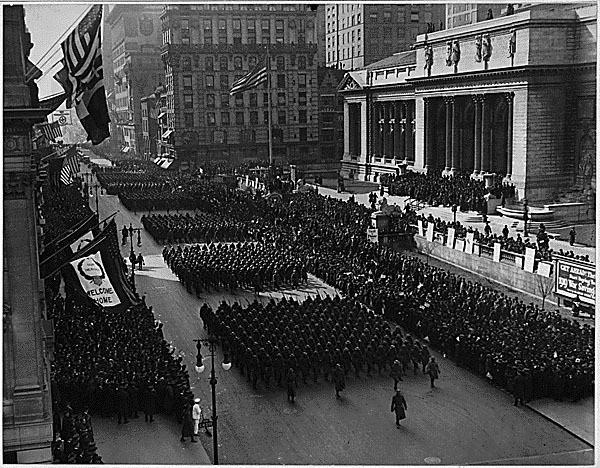
They came home to a parade New York couldn’t fake if it tried. On February 17, 1919, the 369th Infantry Regiment stepped off at 23rd Street and marched a route that ran more than seven miles up Fifth Avenue toward 145th—past a reviewing stand at 60th Street where Al Smith and John Hylan sat in official comfort watching men who’d earned none of their comfort for them. The sidewalks were packed—accounts describe a mixed crowd, block after block, deep enough that the soldiers themselves were stunned by the scale. And it didn’t sound like a polite civic clap either: the band led, and the opening hit with “bugle fanfares,” then that unmistakable jazz bite—saxophones and basses adding what one paper called a “peppery tang”—turning a military procession into a moving Black soundtrack the city had to swallow whole.
Then the march pushed uptown, and the temperature changed. As they turned off Fifth onto Lenox Avenue, reports say the welcome got louder—people crammed sidewalks and jammed windows just to get eyes on “their soldiers.” They threw what they had—flowers, candy, cigarettes—like the neighborhood was trying to touch the moment before it disappeared. Even the moneyed white spectators played their part; Henry Frick waved a flag from his mansion steps while Harlem made the real ceremony: not the state’s applause, but the community’s recognition. And there was Henry Johnson—rolling in the lead car, lilies in hand—while the crowd roared the nickname that Europe had already stamped on him: “Black Death.”
And after the marching? The love didn’t vanish—it concentrated. The New York Times estimated 10,000 people waiting outside the Park Avenue Armory, with the spaces around it packed with Black women and girls, pressing close just to be near the men who’d come back alive. Inside, the soldiers ate fast—because even a celebration had a clock on it—then pushed back out to find family in the crush.
And then the performance ended.
Watching the Party Die: Demobilized Into Disposability
Then came the quiet part: paperwork and the trapdoor. The 369th Infantry Regiment was officially demobilized on February 28, 1919—the fastest way for a nation to turn living proof into past tense. One day, you’re “historic.” The next day, you’re just another Black man trying to make rent in a country that never stopped seeing you as a problem to manage.
And the men walked straight back into the same architecture that had tried to keep them out of combat in the first place: Jim Crow logic, Northern “polite” segregation, employers who loved Black labor and feared Black confidence, landlords and banks who treated Black neighborhoods like mistakes that should’ve never been financed. The Library of Congress puts it clean: beyond the public celebration, Black veterans returned to pervasive discrimination and de facto segregation, North and South. The system didn’t need new ideas to contain them—it already had a full toolkit.

Even the “benefits” came with conditions. A uniform didn’t inoculate them from humiliation in the hospitals their bodies had earned. Black soldiers and veterans pushed back—writing officials, demanding care, forcing the government to confront its own contradictions—because unequal treatment was baked into the early veterans’ health system, and Black patients knew it. The fight didn’t end overseas; it just moved into wards, waiting rooms, and bureaucratic offices that suddenly went deaf when the claimant was Black.
And when America finally handed out flowers, it still made sure the bouquet arrived late. Henry Johnson—celebrated by France during the war—didn’t receive the U.S. Medal of Honor until 2015, posthumously. A century-long pause isn’t “oversight.” It’s the country negotiating with itself about whether Black valor is safe to admit.
Even the cultural victory—the part they can’t steal without admitting who made it—carried its own brutality. James Reese Europe and the Hellfighters band went right back to work after demobilization, launching a major tour in March 1919. And then Europe was killed that May, stabbed by a member of his own band. The man who scored a movement’s return home didn’t get a long life in the “land of the free.”
So that’s what came after: not a fairy tale, not a clean “they were finally respected,” but the familiar American exchange rate—Black excellence traded for white comfort, then cashed out into Black disposability.
Excellence Is Not Liberation
Let me say the plain thing, because this is what the whole story has been dragging into the light: If excellence could purchase freedom, Black people would’ve been free before your grandparents learned the word “civil rights.”
The Hellfighters were not “good enough.” They were extraordinary—decorated, relentless, and so feared their enemies named them like an admission. And they came home to an America that nodded once and returned to its favorite ritual: pretending nothing had to change.
Because the system was never confused about Black ability. It has never been confused. The question was never whether we could do it. The question was whether we’d be allowed to live like it meant anything. And that answer is structural. You do not defeat a structure by impressing it. You defeat a structure by dismantling it.
So don’t take this story as a motivational poster. The lesson of the 369th is not “try harder.” We have tried harder—fought harder—built harder—created harder—while this country took notes, took credit, and kept the cage.
What we are owed is not praise. Not symbolism. Not a yearly moment of scripted gratitude.
We are owed power, safety, infrastructure, protection, full rights, and a damn receipt.
Now sit with the real question America refuses to ask: what would this country be if it believed in Black excellence enough to fund it, protect it, and follow it—instead of policing it, plundering it, and lynching it? How many breakthroughs never happened because the inventor was buried early? How many movements never matured because the leader was targeted? How many schools, hospitals, neighborhoods, and futures never got built because the nation keeps treating Black brilliance like a threat instead of a national asset?
Everything else is just another parade.
One last shot . . . Less than 5% of our readers are backing this work. We only need 13% to donate a couple of cups of coffee a month to change everything — Flow Lounge events in San Francisco and San Jose, real paychecks for local artists, and hundreds more people touched by this Culture every year. If this work matters to you, be one of the 13%. 👉🏾 www.HipHopForTheFuture.org


Black power was only a weapon because white people fought against it. People don't need a recap on how the modern day community started.